FAT BURNING & WEIGHT LOSS
Understand how your body burns fat and achieve lasting results.
Losing weight seems simple, but many people find it harder than expected. Even with regular exercise and eating less, the results they want don’t always follow.
How exactly does fat burning work? Should you eat less or move more? Is cardio better than strength training? And how can you lose body fat without losing valuable muscle mass?
On this page, we explain how your body uses energy, what affects fat loss, and how the right combination of nutrition, training, and recovery can help you lose weight effectively and safely.
No crash diets or miracle cures, just science-based knowledge to help you achieve lasting results.
HOW DOES OUR BODY USE ENERGY?
To understand how fat burning works, we first need to understand how our body uses energy.
Our total daily energy expenditure, or TDEE, consists of four main components:
1. Basal metabolic rate (BMR)
The energy your body needs at complete rest to maintain vital functions such as breathing, circulation, and organ function. For many people, this accounts for about 60 to 75% of daily energy expenditure.
2. Daily movement (NEAT)
The energy you use during daily activities such as walking, working, doing household tasks, and climbing stairs.
3. Exercise and training (EAT)
The additional energy used during purposeful physical activity, such as strength training, cycling, and cardio.
4. Food digestion (TEF)
Digesting, absorbing, and processing nutrients also requires energy.
What energy sources does our body use?
Our body mainly uses carbohydrates and fats for fuel. The proportion of each changes constantly, depending on factors such as exercise intensity, diet, and hormonal conditions.
In the video alongside, Gary Brecka shares his perspective on how these energy sources are used. It’s important to note that our body can use carbohydrates and fats at the same time. Glycogen stores don’t need to be completely depleted before fat burning occurs.
Ultimately, energy balance over an extended period is the main factor in lasting fat loss.
HOW DOES FAT BURNING WORK?
Our body needs energy all the time—not just during exercise, but also while we sleep, breathe, and our organs function.
Our body gets this energy mainly from carbohydrates and fats. Excess energy can be stored in fat cells as an energy reserve.
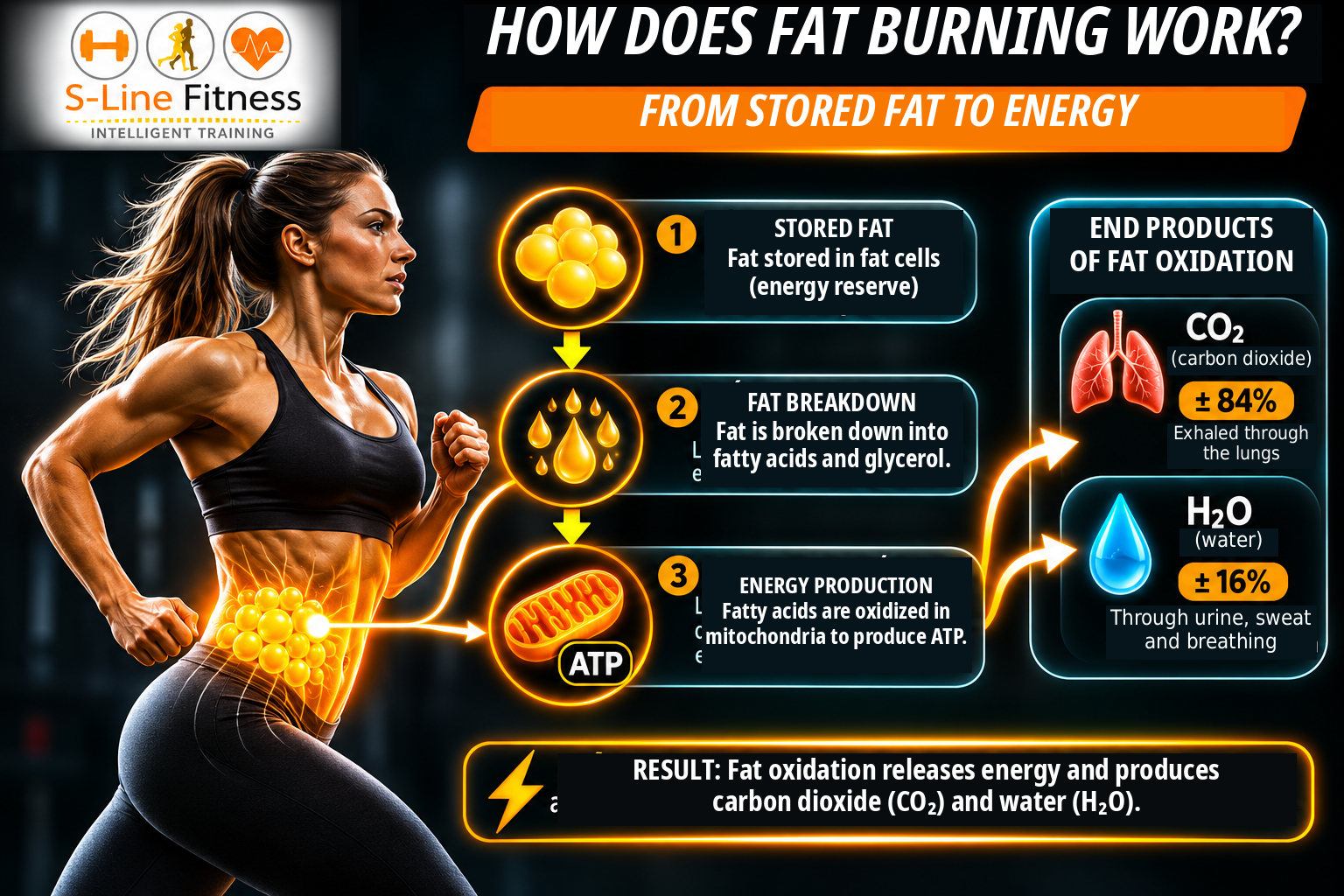
When the body uses more energy than it gets from food, it can draw on these fat reserves. Stored fats are broken down into fatty acids and glycerol. Cells can then use the fatty acids to produce energy.
Did you know that most of the fat you lose leaves your body through breathing?
Burning fat produces carbon dioxide (CO₂) and water. We breathe out the carbon dioxide, while water leaves the body through urine, sweat, and breathing, among other routes.
Fat burning happens all the time, even at rest. However, burning more fat during a workout doesn’t automatically mean you’ll lose more body fat. Your energy balance over an extended period is what matters most.
WEIGHT LOSS OR FAT LOSS?
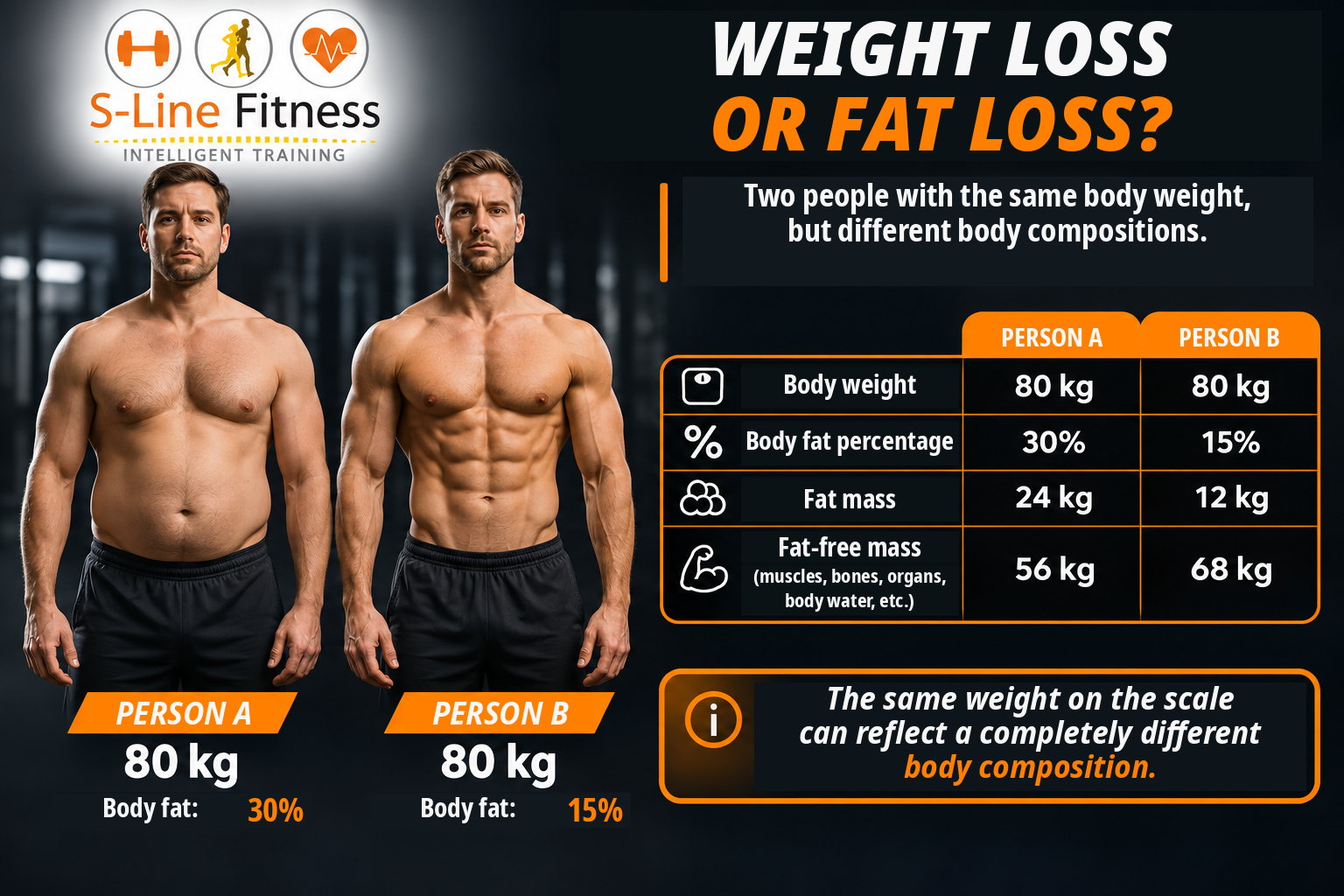
Weight loss and fat loss aren’t the same thing. Your body weight includes muscle mass, body fat, bones, and body water, among other components.
When you lose weight, it doesn’t necessarily mean you’re losing only fat. Strict diets without enough protein and strength training can put you at risk of losing muscle mass too.
The goal isn’t just to weigh less, but to improve your body composition.
Muscle mass plays an important role in your strength, mobility, energy expenditure, and overall health. That’s why it’s important to preserve as much muscle mass as possible while losing weight.
It’s even possible to lose body fat and build muscle at the same time, especially if you’re new to exercise. This means your weight may stay relatively stable while your body composition improves significantly.
At S-Line Fitness, we look beyond the number on the scale. By tracking your body composition and strength gains, you get a clearer picture of your actual progress.
A lower body fat percentage, greater strength, and a healthier body matter more than a lower body weight alone.
ENERGY BALANCE & CALORIE DEFICIT
Energy balance is one of the most important principles in losing body fat. It describes the relationship between the energy you get from food and the energy your body uses.
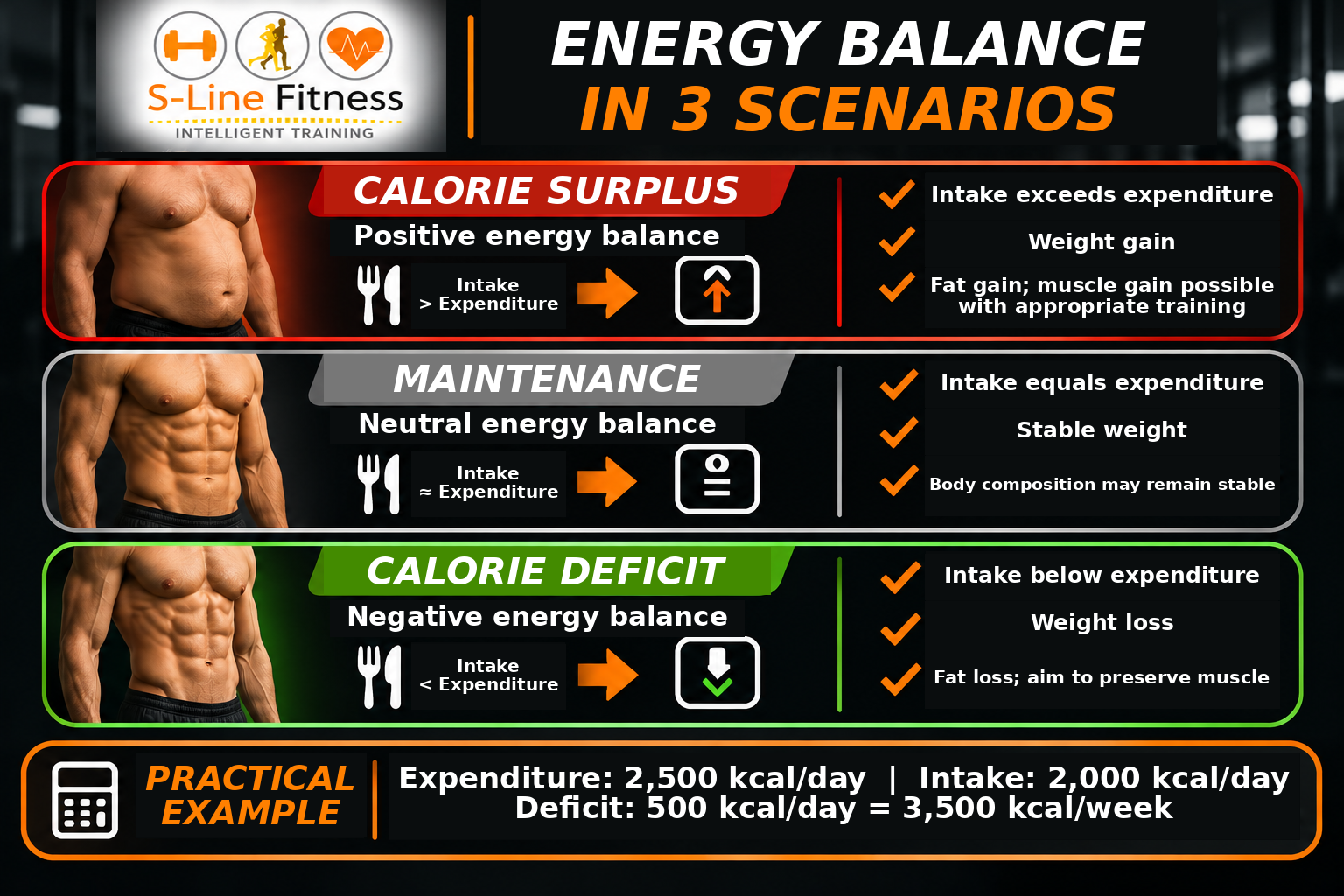
There are three possible scenarios:
Positive energy balance – calorie surplus
You take in more energy than your body uses. Over time, this can lead to weight gain from an increase in body fat and, with the right training, muscle mass.
Neutral energy balance – maintenance
Your energy intake roughly matches your energy expenditure. Your body weight stays relatively stable over time.
Negative energy balance – calorie deficit
You take in less energy than your body uses. Your body has to draw on its energy reserves, allowing you to lose body fat.
A practical example:
Suppose you use 2,500 kcal a day and take in 2,000 kcal from food. That creates a daily calorie deficit of 500 kcal, or 3,500 kcal per week.
In theory, this corresponds to about 450 grams of body fat per week. In practice, results can vary due to changes in body water, energy expenditure, and body composition.
A moderate calorie deficit of 300 to 500 kcal per day, for example, can be a suitable starting point for many adults, depending on their individual circumstances.
A larger calorie deficit isn’t necessarily better. An overly restrictive diet can lead to fatigue, muscle loss, reduced training performance, and an eating pattern that’s harder to maintain.
The goal isn’t to eat as little as possible, but to eat enough while creating a safe calorie deficit.
S-LINE CALORIE CALCULATOR
A calorie deficit may not be suitable for your situation. Seek personalized advice.
Calculation based on the Mifflin-St Jeor equation. Results are estimates for adults, not personalized dietary advice. Not intended for pregnancy, breastfeeding, eating disorders, or specific medical dietary needs.
Did you know?
At S-Line Fitness, we also measure your body fat percentage
and determine your fat-free mass. This allows us
to provide a more personalized estimate of your energy needs
and better tailor your nutrition program.
CALCULATE YOUR DAILY ENERGY NEEDS
How many calories does your body need each day? That varies from person to person and depends on factors including your age, sex, height, body weight, and activity level.
Our calorie calculator gives you a personalized estimate of your basal metabolic rate (BMR) and total daily energy expenditure (TDEE).
Based on these estimates, you can see your calorie needs for three different goals:
- Fat loss: create a safe calorie deficit.
- Weight maintenance: match your energy intake to your energy expenditure.
- Muscle gain: combine a modest calorie surplus with targeted strength training.
The calculator uses the Mifflin-St Jeor equation, a science-based method for estimating energy expenditure at rest.
A more personalized calculation at S-Line Fitness
At S-Line Fitness, we go a step further. By measuring your body fat percentage as well as your body weight, we gain insight into your body composition and fat-free mass.
Two people with the same body weight can have different energy expenditures because of differences in their body composition.
These additional measurements help us estimate your energy needs more accurately and tailor your nutrition and training program to your body and personal goals.
By measuring your body composition regularly, we can also track your progress and adjust your nutrition program when needed.
Knowledge starts with measurement. Effective training and nutrition begin with understanding your own body.
CARDIO OR STRENGTH TRAINING?
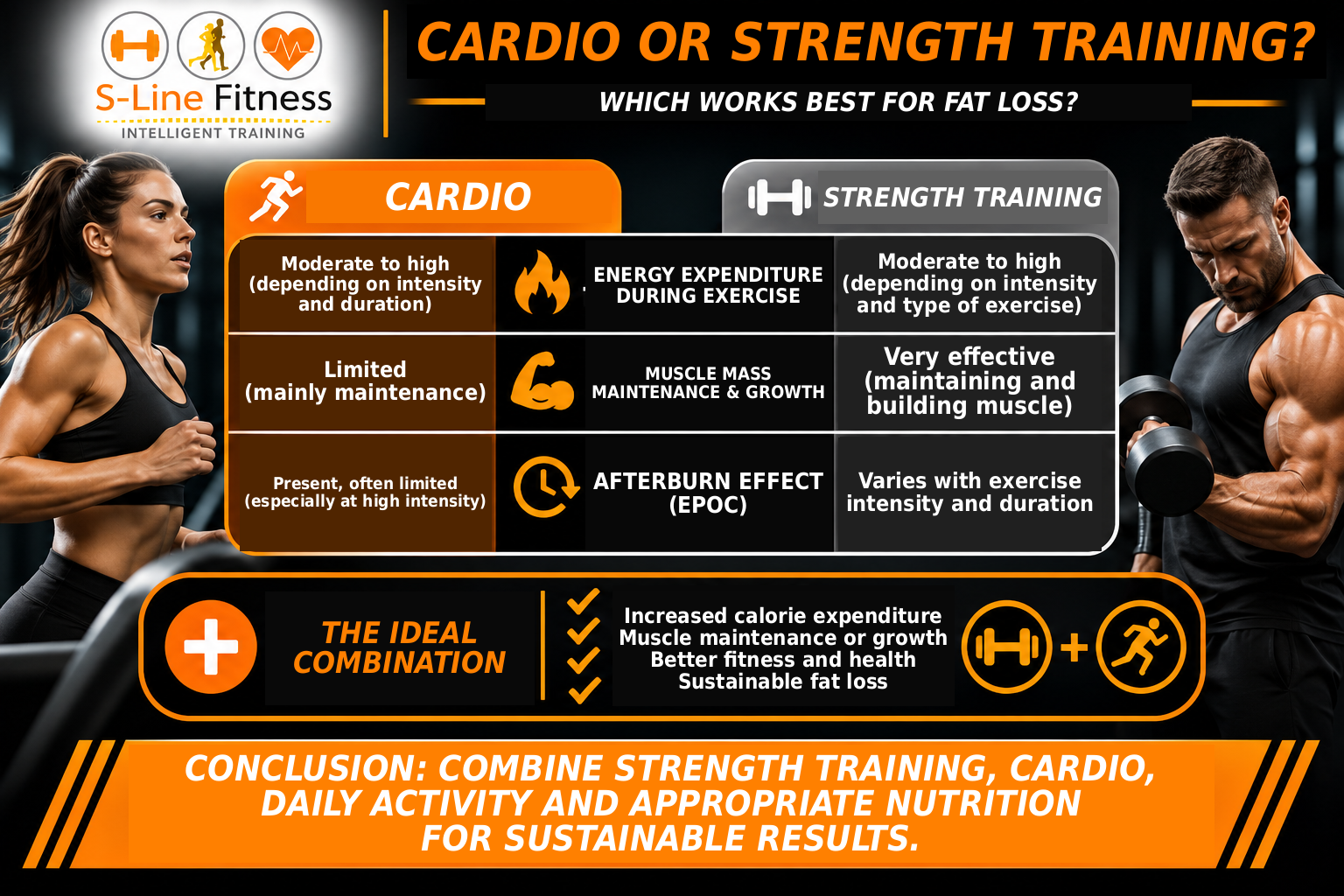
What’s the best way to lose body fat: cardio or strength training? Both have their benefits, but they play different roles in improving your body composition.
Cardio training
Activities such as walking, cycling, running, and rowing increase your energy expenditure. Cardio training also improves your fitness, endurance, and cardiovascular health.
During lower-intensity exercise, the body generally uses a greater proportion of fat for energy. At higher intensities, the proportion of carbohydrates increases. However, this doesn’t mean that low-intensity training automatically leads to more body fat loss.
Strength training
Strength training plays an essential role in preserving and building muscle mass. It’s especially important to keep challenging your muscles when you’re in a calorie deficit.
Muscle tissue uses energy even at rest. Preserving muscle mass therefore helps limit some of the decrease in energy expenditure during weight loss.
The afterburn effect (EPOC)
After an intense workout, your energy expenditure can remain elevated temporarily. Your body needs extra energy to recover and return to its normal state. This effect is real, but its contribution to total daily energy expenditure is often overestimated.
The ideal combination
For lasting fat loss, a combination of strength training, cardio, sufficient daily movement, and appropriate nutrition is generally the best approach.
At S-Line Fitness, we combine targeted strength training with EGYM, traditional strength machines, and cardio training, tailored to your abilities and personal goals.
Don’t train just to burn calories. Train to preserve your muscles, get stronger, and improve your health too.
LOSE WEIGHT WITHOUT LOSING MUSCLE
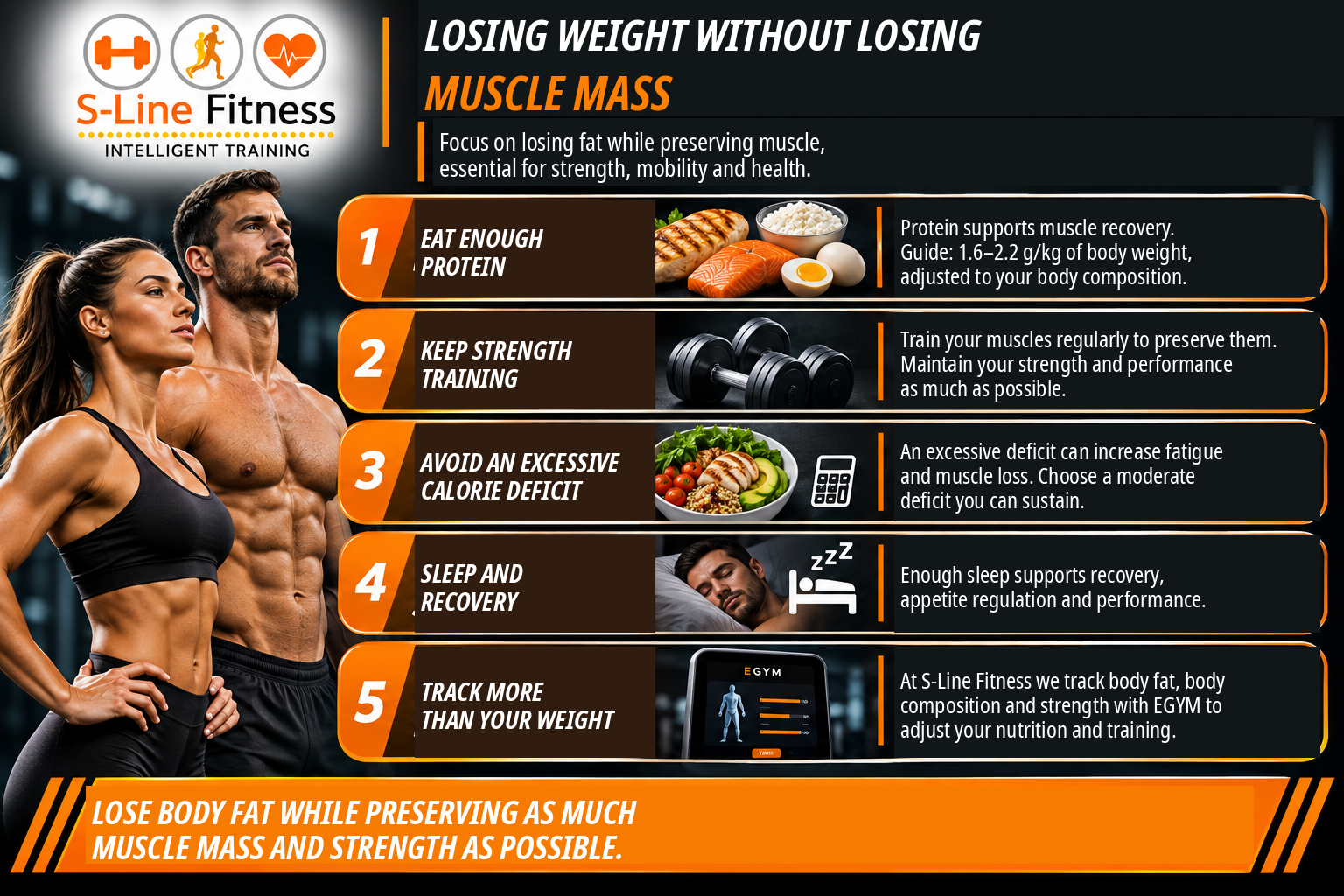
When losing weight, you want to lose primarily body fat while preserving as much muscle mass as possible. Muscle mass is important for your strength, mobility, energy expenditure, and overall health.
How can you avoid unnecessary muscle loss while losing weight?
1. Get enough protein
Protein provides the amino acids your body needs for muscle recovery and growth. Getting enough protein is especially important when you’re in a calorie deficit.
For healthy adults who strength train regularly, a daily protein intake of about 1.6 to 2.2 grams per kilogram of body weight is often a suitable guideline. For those with a high body fat percentage, a calculation based on adjusted body weight may be more appropriate.
2. Keep strength training
Regularly challenging your muscles gives your body an important reason to preserve muscle mass. Aim to maintain your strength and training performance as much as possible while losing weight.
3. Avoid an excessive calorie deficit
An extreme calorie deficit increases the risk of muscle loss, fatigue, and reduced training performance. Choose a moderate deficit you can maintain over a longer period.
4. Get enough sleep and recovery
During recovery, your body adapts to the demands of training. Enough sleep supports muscle recovery, appetite regulation, and training performance.
5. Measure more than just your weight
At S-Line Fitness, we can track your body fat percentage, body composition, and strength gains. EGYM strength measurements also allow us to objectively assess changes in your strength performance.
This allows us to make targeted adjustments to your nutrition and training program.
Successful weight loss isn’t just about weighing less. It’s about losing body fat while preserving as much muscle mass and strength as possible.
CAN YOU TARGET BELLY FAT?
Many people specifically want to lose fat around their belly, hips, or thighs. But is it possible to burn fat in a specific area by doing certain exercises?
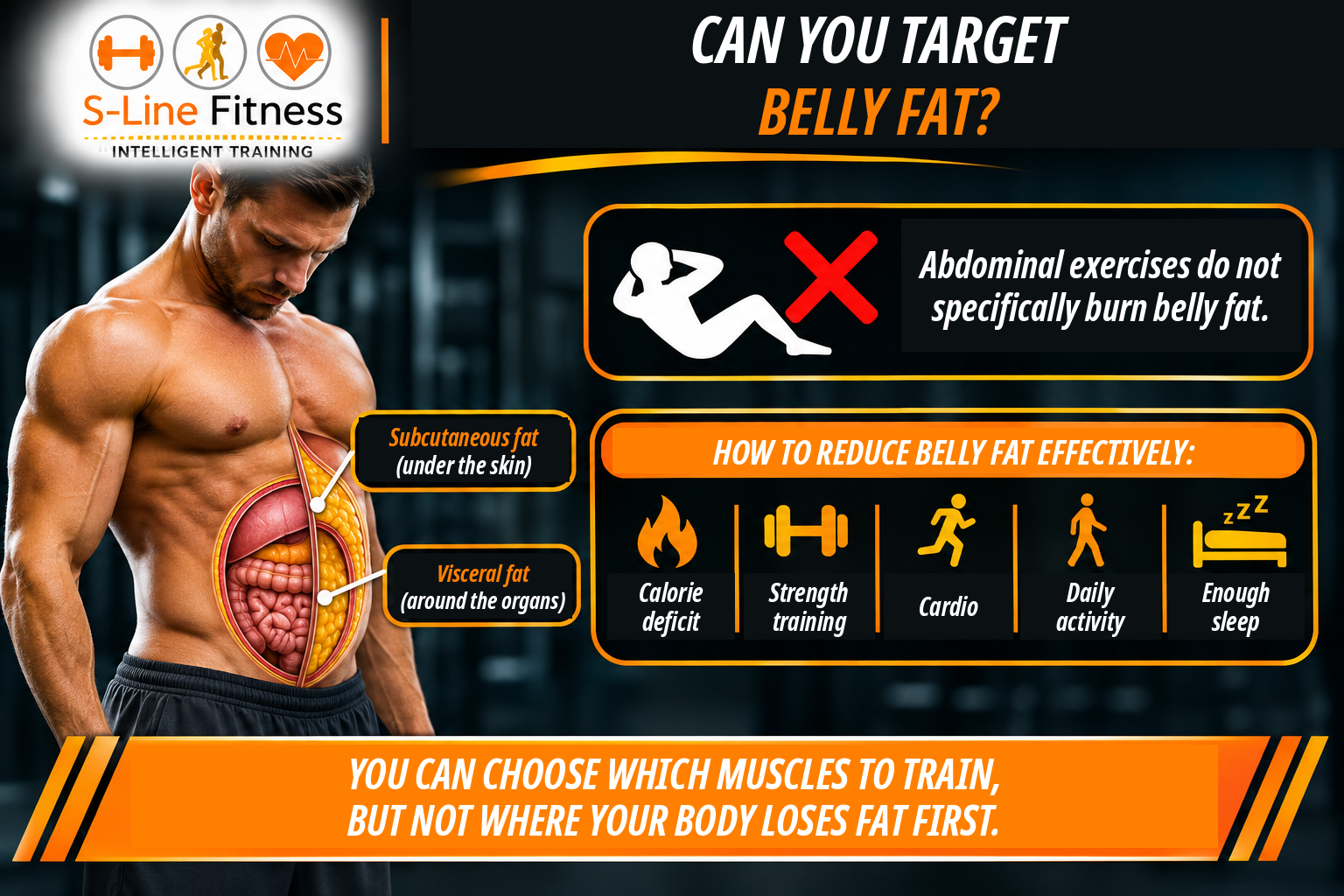
Ab exercises don’t specifically burn belly fat.
Ab exercises strengthen and develop your abdominal muscles. However, that doesn’t mean the body fat covering them will automatically disappear.
When your body draws on its fat reserves, it does so throughout the body. Where you lose fat first or last is influenced by factors including genetics, age, sex, and hormones.
Subcutaneous fat and visceral fat
There are two main types of fat around the abdomen:
- Subcutaneous fat: the fat directly beneath the skin that you can pinch.
- Visceral fat: the fat located deeper in the abdominal cavity around your internal organs.
Excess visceral fat is associated with an increased risk of cardiovascular disease, type 2 diabetes, and other health problems.
Reducing belly fat isn’t just an aesthetic goal—it can also offer important health benefits.
How can you reduce belly fat effectively?
A safe calorie deficit, regular strength training, cardio, enough daily movement, and quality sleep all help reduce body fat, including belly fat.
At S-Line Fitness, we look beyond your body weight and track your body composition to better assess your actual progress.
You can choose which muscles you train, but not where your body loses fat first.
WHY HAS YOUR WEIGHT LOSS STALLED?
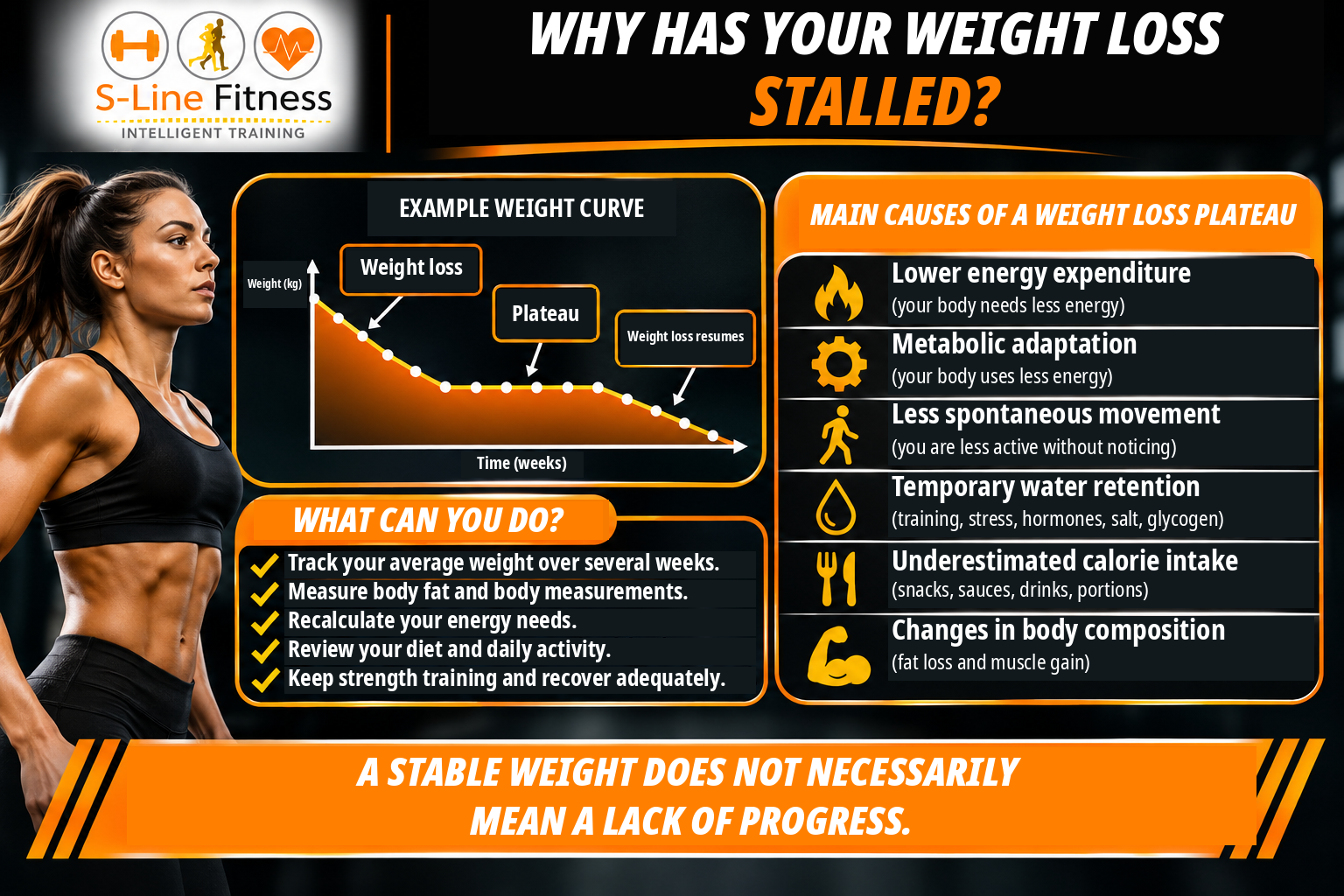
You’re eating less, training regularly, and initially losing weight. But suddenly, the scale seems to stop moving. This is known as a weight-loss plateau.
A plateau doesn’t necessarily mean you’ve stopped losing body fat.
1. Your body uses less energy
As you lose weight, your body needs less energy to function and move. As a result, the calorie deficit you started with can gradually become smaller.
2. Metabolic adaptation
During an extended period of calorie restriction, your body may adapt by reducing energy expenditure further. This is called adaptive thermogenesis. Your metabolism isn’t damaged; it’s adapting to changing conditions.
3. You’re moving less without realizing it
During a calorie deficit, your spontaneous daily movement may decrease. You walk less, sit still more often, and make fewer small movements. Your daily energy expenditure can drop without you noticing.
4. You’re temporarily retaining more water
Intense training, stress, hormonal fluctuations, salt intake, and changes in your glycogen stores can temporarily affect your body weight. This can hide actual fat loss on the scale.
5. You’re underestimating your calorie intake
Small snacks, sauces, drinks, and larger portions can add up to more calories than you realize.
6. Your body composition is changing
When you lose body fat and build muscle at the same time, your weight may stay relatively stable while your body composition improves.
What can you do about a weight-loss plateau?
- Assess your average body weight over several weeks.
- Track your body fat percentage and body measurements too.
- Recalculate your energy needs.
- Review your eating habits and daily movement.
- Keep strength training and get enough recovery.
At S-Line Fitness, we track more than just your body weight. We also monitor your body composition, body fat percentage, and strength gains. This helps us better assess whether an adjustment to your nutrition or training program is really necessary.
A scale that isn’t moving doesn’t automatically mean you’ve stopped making progress.
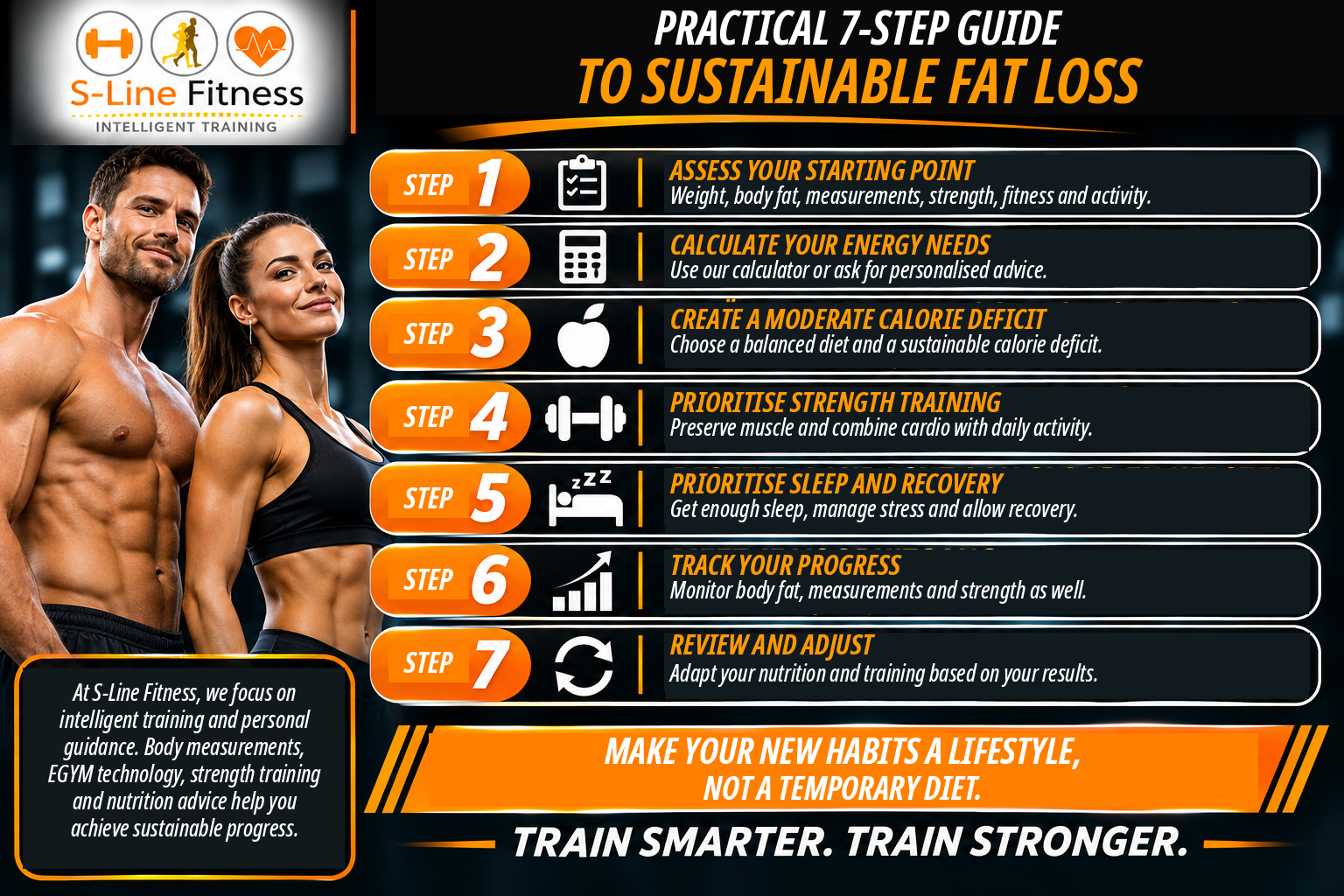
A PRACTICAL STEP-BY-STEP PLAN FOR LASTING FAT LOSS
Now that you understand how energy expenditure, fat burning, and body composition work, it’s time to put that knowledge into practice.
STEP 1 – Establish your starting point
Measure your body weight, body fat percentage, and body measurements. Also assess your current strength, fitness, and daily activity.
STEP 2 – Calculate your daily energy needs
Determine how much energy your body needs each day. Use our calorie calculator or get a more personalized calculation based on your body composition at S-Line Fitness.
STEP 3 – Create a safe calorie deficit
Choose a moderate calorie deficit and a balanced eating pattern you can maintain long term. Make sure you get enough protein, fiber, healthy fats, vitamins, and minerals.
STEP 4 – Make strength training a priority
Train regularly to preserve as much muscle mass and strength as possible. Combine strength training with cardio and enough daily movement.
STEP 5 – Pay attention to sleep and recovery
Aim for enough quality sleep, limit excessive stress, and give your body enough time to recover.
STEP 6 – Measure your progress
Don’t focus solely on the number on the scale. Track your body fat percentage, body measurements, strength gains, and overall fitness too.
STEP 7 – Evaluate and adjust
Adjust your nutrition and training when your results call for it. Avoid making hasty decisions based on daily weight fluctuations.
Make your new habits a lifestyle, not a temporary diet.
At S-Line Fitness, we believe in smart training, personalized guidance, and lasting results—not quick fixes. Our combination of body measurements, EGYM technology, strength training, and nutritional guidance helps you work toward your goals safely and effectively.
TRAIN SMARTER. TRAIN STRONGER.
READY TO ACHIEVE YOUR GOALS?
Knowledge is the first step. Putting it into practice makes the difference.
At S-Line Fitness, we help you turn your knowledge into lasting results. With personalized body measurements, strength assessments, EGYM technology, targeted training, and nutritional guidance, we tailor your program to your body and personal goals.
Discover how we can support you during a free, no-obligation consultation.
TRAIN SMARTER. TRAIN STRONGER.
SCIENTIFIC SOURCES & REFERENCES
The information on this page is based on findings from nutritional science, exercise physiology, and scientific research on body composition.
1. Energy expenditure and basal metabolic rate
Mifflin et al. (1990) – American Journal of Clinical Nutrition. Research on estimating energy expenditure at rest. This equation forms the basis of our calorie calculator.
View the study
2. The physiological process of fat burning
Meerman & Brown (2014) – British Medical Journal. An explanation of body fat breakdown and its elimination as carbon dioxide and water.
View the publication
3. Nutrition, protein, and weight loss
International Society of Sports Nutrition (2026). A scientific position stand on nutritional strategies, calorie deficits, protein requirements, muscle preservation, and metabolic adaptations during weight loss.
View the publication
4. Strength training and body composition
Obesity Reviews (2022). A systematic review and meta-analysis of the effects of strength training on body fat, body weight, and fat-free mass.
View the study
5. Protein intake and muscle growth
Morton et al. (2018) – British Journal of Sports Medicine. A systematic review and meta-analysis of the effects of protein on muscle mass and strength gains.
View the study
6. Physical activity, fat loss, and visceral fat
Obesity Reviews (2021). An overview of 12 systematic reviews and 149 studies on the effects of physical activity on weight loss and body composition.
View the study
7. Calorie deficit and muscle preservation
Scandinavian Journal of Medicine & Science in Sports (2022). A meta-analysis of the effects of an energy deficit on muscle mass and strength gains during strength training.
View the study
Disclaimer
The information on this page is for educational purposes and does not replace individualized medical or dietary advice. The calorie calculator results are estimates. Individual results may vary.